|
|
樓主 |
發表於 2014-3-4 15:22:47
|
顯示全部樓層
本帖最後由 toppas 於 2014-3-4 15:19 編輯
Below is the History of Indian before 1954.
Unfortunately, Its only English. Sorry Ching.


Indian is an American brand of motorcycles originally manufactured from 1901 to 1953 by a company in Springfield, Massachusetts, US, initially known as the Hendee Manufacturing Company but which was renamed the Indian Motocycle Manufacturing Company in 1928.
The Indian factory team took the first three places in the 1911 Isle of Man Tourist Trophy. During the 1910s Indian became the largest manufacturer of motorcycles in the world. Indian's most popular models were the Scout, made from 1920 to 1946, and the Chief, made from 1922 to 1953.
The Indian Motocycle Manufacturing Company went bankrupt in 1953. A number of successor organizations have perpetuated the name in subsequent years, with limited success. In 2011 Polaris Industries purchased Indian Motorcycles and relocated operations from North Carolina, merging them into existing facilities in Minnesota and Iowa. Since August 2013, three motorcycle models that capitalize on Indian's traditional styling have been built under the Indian name.

Carl Oscar Hedström with the first prototype of Indian
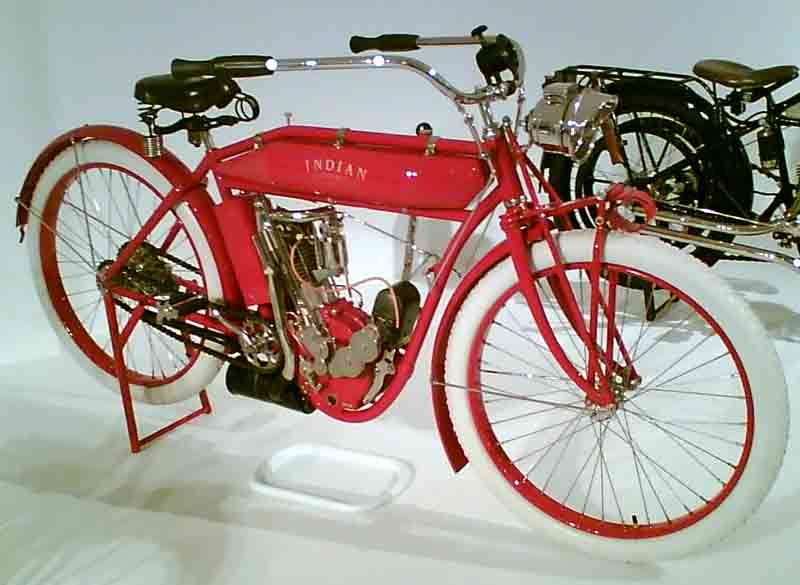
Indian 1911
In 1905, Indian built its first V-twin factory racer, and in following years made a strong showing in racing and record-breaking. In 1907 the company introduced the first street version V-twin and a roadster styled after the factory racer. The roadster can be distinguished from the racers by the presence of twist grip linkages. One of the firm's most famous riders was Erwin "Cannonball" Baker, who set many long-distance records. In 1914, he rode an Indian across America, from San Diego to New York, in a record 11 days, 12 hours and ten minutes. Baker's mount in subsequent years was the Powerplus, a side-valve V-twin, which was introduced in 1916. Its 61ci (1000 cc), 42 degree V-twin engine was more powerful and quieter than previous designs, giving a top speed of 60 mph (96 km/h). The Powerplus was highly successful, both as a roadster and as the basis for racing bikes. It remained in production with few changes until 1924.
"Wouldn't You Like to Be With Them?" A 1915 advertisement for the Indian Motocycle.
Competition success played a big part in Indian's rapid growth and spurred technical innovation, as well. One of the American firm's best early results came in the Isle of Man TT in 1911, when Indian riders Oliver Cyril Godfrey, Franklin and Moorehouse finished first, second and third. Indian star Jake DeRosier set several speed records both in America and at Brooklands in England, and won an estimated 900 races on dirt and board track racing. He left Indian for Excelsior and died in 1913, aged 33, of injuries sustained in a board track race crash with Charles "Fearless" Balke, who later became Indian's top rider. Work at the Indian factory was stopped while DeRosier's funeral procession passed.
Oscar Hedstrom left Indian in 1913 after disagreements with the Board of Directors regarding dubious practices to inflate the company's stock values. George Hendee resigned in 1916.

Indian lightweights 1916-1919
Indian introduced the 221 cc single cylinder two-stroke Model K "Featherweight" in 1916. The Model K had an open cradle frame with the engine as a stressed member and a pivoting front fork that had been used earlier on single-cylinder motorcycles but had mostly been replaced on other Indian motorcycles by a leaf-sprung trailing link fork.
The Model K was manufactured for one year and was replaced in 1917 by the Model O. The Model O had a four-stroke flat-twin engine and a new frame, but retained the pivoting fork at the front. The Model O was manufactured until 1919.
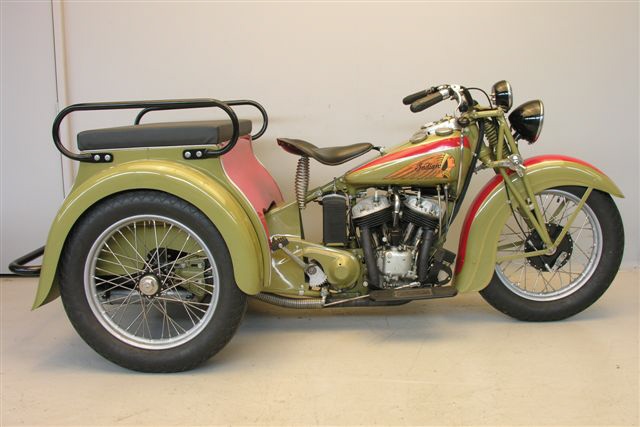
1939 Indian Dispatch Tow, 3-wheeler

1928 Indian Big Chief with sidecar
Indian Chief
The first 1922 model Chief had a 1,000 cc (61 cubic inches) engine based on that of the Powerplus; a year later the engine was enlarged to 1,200 cc (73 cubic inches). Numerous improvements were made over the years, including adoption of a front brake in 1928.
In 1940, all models were fitted with the large skirted fenders that became an Indian trademark, and the Chief gained a new sprung frame that was superior to rival Harley's unsprung rear end. The 1940s Chiefs were handsome and comfortable machines, capable of 85 mph (137 km/h) in standard form and over 100 mph (160 km/h) when tuned, although their increased weight hampered acceleration.
The 1948 Chief had a 74 cubic inch engine, hand shift and foot clutch. While one handlebar grip controlled the throttle the other was a manual spark advance.
In 1950, the V-twin engine was enlarged to 1,300 cc (79 cubic inches) and telescopic forks were adopted. But Indian's financial problems meant that few bikes were built. Production of the Chief ended in 1953.
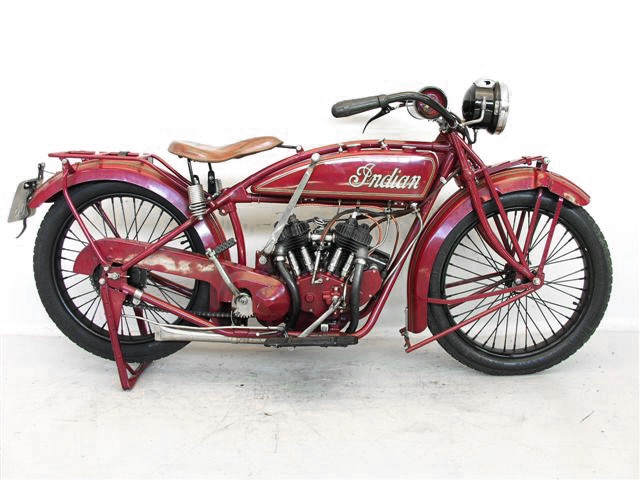
1920 Indian Scout
The Indian Scout was built from 1920 to 1949. It rivaled the Chief as Indian's most important model.
The Scout was introduced for 1920. Designed by Charles B. Franklin, the Scout had its gearbox bolted to the engine and driven by gears instead of by belt or chain.[14] The engine originally displaced 37 cu in (610 cc); the Scout 45, with a displacement of 45 cu in (740 cc), became available in 1927 to compete with the Excelsior Super X. A front brake became standard on the original Scout early in 1928.
Later in 1928, the Scout and Scout 45 were replaced by the Model 101 Scout. Another Franklin design, the 101 Scout had a longer wheelbase and lower seat height than the original. The 101 Scout was well-known for its handling.
The 101 Scout was replaced by the Standard Scout for 1932. The Standard Scout shared its frame with the Chief and the Four; as a result, the Standard Scout was heavier and less nimble than the 101.
A second line of Scouts was introduced for 1933. Based on the frame of the discontinued Indian Prince single-cylinder motorcycle, the Motoplane used the 45 cubic inch engine from the Standard Scout while the Pony Scout had a reduced displacement of 30.5 cu in (500 cc). In 1934 the Motoplane was replaced by the Sport Scout with a heavier but stiffer frame better able to withstand the power of the 45 cubic inch engine, while the Pony Scout, later renamed the Junior Scout, was continued with the Prince/Motoplane frame. Between the introduction of the Sport Scout in 1934 and the discontinuation of the Standard Scout in 1937 there were three Scout models (Pony/Junior, Standard, and Sport) with three different frames. The Sport Scout and the Junior Scout were continued until civilian production was interrupted in early 1942.

1928 Indian 402
Indian purchased the ownership of the name, rights, and production facilities of the Ace Motor Corporation in 1927. Production was moved to Springfield and the motorcycle was marketed as the Indian Ace for one year.
In 1928, the Indian Ace was replaced by the Indian 401, a development of the Ace designed by Arthur O. Lemon, former Chief Engineer at Ace, who was employed by Indian when they bought Ace.The Ace's leading-link forks and central coil spring were replaced by Indian's trailing-link forks and quarter-elliptic leaf spring.
By 1929, the Indian 402 would have a stronger twin-downtube frame based on that of the 101 Scout and a sturdier five-bearing crankshaft than the Ace, which had a three-bearing crankshaft.
1939 Indian 4, in the "World's Fair" color scheme, in commemoration of the 1939 New York World's Fair. On display at Clark's Trading Post, Lincoln, New Hampshire.
Despite the low demand for luxury motorcycles during the Great Depression, Indian not only continued production of the Four, but continued to develop the motorcycle. One of the less popular versions of the Four was the "upside down" engine on the 1936-1937 models. While earlier (and later) Fours had inlet-over-exhaust (IOE) cylinder heads with overhead inlet valves and side exhaust valves, the 1936-1937 Indian Four had a unique EOI cylinder head, with the positions reversed. In theory, this would improve fuel vaporization, and the new engine was more powerful. However, the new system made the cylinder head, and the rider's inseam, very hot. This, along with an exhaust valvetrain that required frequent adjustment, caused sales to drop. The addition of dual carburetors in 1937 did not revive interest. The design was returned to the original configuration in 1938.
Like the Chief, the Four was given large, skirted fenders and plunger rear suspension in 1940. In 1941, the 18-inch wheels of previous models were replaced with 16-inch wheels with balloon tires.
The Indian Four was discontinued in 1942. Recognition of the historical significance of the 1940 four-cylinder model was made with an August 2006 United States Postal Service 39-cent stamp issue, part of a four panel set entitled American Motorcycles. A 1941 model is part of the Smithsonian Motorcycle Collection on display at the National Museum of American History.

1942 Indian Scout 500, the 741, used by the US Army.

1950 Indian Chief Black Hawk
Post-war decline and demise
1950 Indian Chief Black Hawk
In 1945, a group headed by Ralph B. Rogers purchased a controlling interest of the company. On November 1, 1945, duPont formally turned the operations of Indian over to Rogers.
Under Rogers' control, Indian discontinued the Scout and began to manufacture lightweight motorcycles such as the 149 Arrow, the Super Scout 249, both introduced in 1949, and the 250 Warrior, introduced in 1950. Production of traditional Indians was extremely limited in 1949, and no 1949 Chiefs are known to exist. Manufacture of all products was halted in 1953.
Thanks for watching
|
|








 在線雷達
在線雷達


 發表於 2014-3-4 15:22:46

 廣播
廣播 置頂
置頂 超級提昇
超級提昇 強效提昇
強效提昇 推舊帖
推舊帖 收嗲鳥
收嗲鳥 油顏色
油顏色


 發表於 2014-3-5 01:16:52