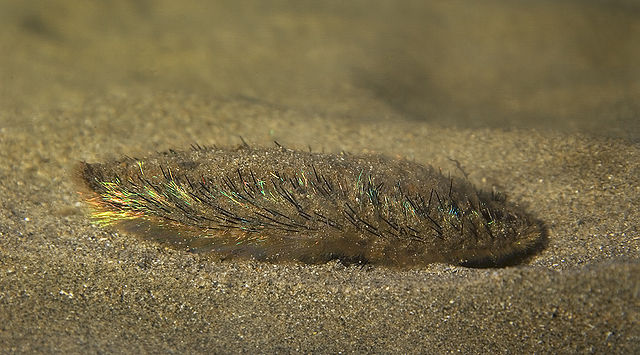
The sea mouse, genus Aphrodita, is a marine polychaete worm found in the North Atlantic, the North Sea, the Baltic Sea and the Mediterranean. The sea mouse normally lies buried head-first in the sand. It has been found at depths of over 2,000 metres (6,600 ft).
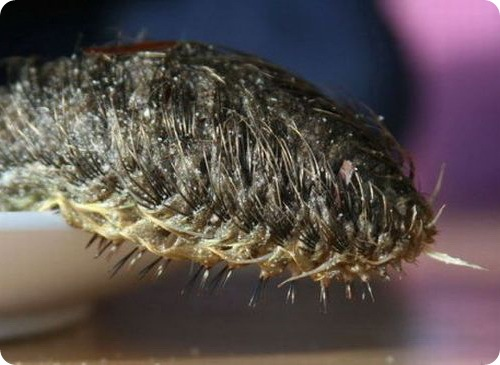
Its body is covered in a "dense mat" of setae (hairlike structures) from which the name "sea mouse" derives. Its scientific name is taken from Aphrodite, Greek goddess of love. This is because, when viewed ventrally, the sea mouse resembles a human female's genitalia. Sea mice generally fall within a range of 7.5 to 15 centimetres (3.0 to 5.9 in), but some grow to 30 centimetres (12 in). They are scavengers, eating the remains of dead and decaying animals. The worm may also be so named because of its resemblance to a "bedraggled mouse" when it washes up on shore.
The spines, or setae,that emerge from the scaled back of the sea mouse are one of its unique features. Normally, these have a red sheen, warning off predators, but when the light shines on them perpendicularly, they flush green and blue, a "remarkable example of photonic engineering by a living organism". These colors are believed to be a defense mechanism, giving warning to potential predators. The effect is produced by many hexagonal cylinders within the spines, which "perform much more efficiently than man-made optical fibres".




 [/img][/img]



 在線雷達
在線雷達


 發表於 2012-12-11 21:44:06
 廣播
廣播 置頂
置頂 超級提昇
超級提昇 強效提昇
強效提昇 推舊帖
推舊帖 收嗲鳥
收嗲鳥 油顏色
油顏色






 發表於 2012-12-12 19:48:50