Chichen Itza , from Yucatec Maya: Chi'ch'èen Ìitsha' [tɕʰɨɪʼtɕʼeːn˧˩ iː˧˩tsʰaʲ]; "at the mouth of the well of the Itza") was a large pre-Columbian city built by the Maya civilization. The archaeological site is located in the municipality of Tinum, in the Mexican state of Yucatán.
Chichen Itza was a major focal point in the northern Maya lowlands from the Late Classic (c.600–900 AD) through the Terminal Classic (c.800–900) and into the early portion of the Early Postclassic period (c.900–1200). The site exhibits a multitude of architectural styles, reminiscent of styles seen in central Mexico and of the Puuc and Chenes styles of the northern Maya lowlands. The presence of central Mexican styles was once thought to have been representative of direct migration or even conquest from central Mexico, but most contemporary interpretations view the presence of these non-Maya styles more as the result of cultural diffusion.
Chichen Itza was one of the largest Maya cities and it was likely to have been one of the mythical great cities, or Tollans, referred to in later Mesoamerican literature. The city may have had the most diverse population in the Maya world, a factor that could have contributed to the variety of architectural styles at the site.
The ruins of Chichen Itza are federal property, and the site’s stewardship is maintained by Mexico’s Instituto Nacional de Antropología e Historia (National Institute of Anthropology and History). The land under the monuments had been privately-owned until 29 March 2010, when it was purchased by the state of Yucatán.
Chichen Itza is one of the most visited archaeological sites in Mexico; an estimated 1.2 million tourists visit the ruins every year. Naica Mine - Gypsum - Selenite
The Naica Mine of Chihuahua, Mexico, is a working mine that is known for its extraordinary crystals. Naica is a lead, zinc and silver mine in which large voids have been found, containing crystals of selenite (gypsum) as large as 4 feet in diameter and 50 feet long. The chamber holding these crystals is known as the Crystal Cave of Giants, and is approximately 1000 feet down in the limestone host rock of the mine. The crystals were formed by hydrothermal fluids emanating from the magma chambers below. The cavern was discovered while the miners were drilling through the Naica fault, which they were worried would flood the mine. The Cave of Swords is another chamber in the Naica Mine, containing similar large crystals.
The cave can reach to temperature near 120 degrees and over 80 percent humidity. The crystals look like icicles but are razor sharp hot. Without specialized suits and equipment, the scientist could experience severe symptoms such as loss of consciousness and elevated blood pressure.
 樓主: Wanbaolung








 在線雷達
在線雷達


 發表於 2012-12-4 15:10:56








 水晶骷髏頭呢 ?





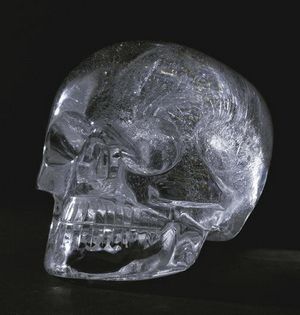
 原來係流料.......









 發表於 2012-12-4 18:35:10
















 →有今生,無來世,向Kobe Bryant致敬•(14/04/2016退役)