The Nile crocodile is the largest crocodilian in Africa and is sometimes regarded as the second largest crocodilian after the Saltwater crocodile. The male crocodile usually measure from 11.5 to 16 feet long (3.5 to 5 meters), but very old, mature ones can grow to 18 ft (5.5 m) or more. Males usually weigh about 1100 lbs (500 kg), but can very large & old specimens can reach up to 2000 lbs (909 kg).[5] The largest accurately measured male was shot near Mwanza, Tanzania and measured 6.45 m (21.3 ft) and weighed approximately 1,090 kg (2,400 lb). Like all crocodiles they are sexually dimorphic, with the males up to 30% larger than the females, though the difference is even more in some species, like the Saltwater crocodile. Mature female nile crocodiles measure 8 to 13 feet long (2.5 to 3.9 meters) and typically weigh 227-300 kg (500-660 lbs). Mata Mata Turtle
Mata Mata Turtle (Chelus fimbriatus, or fimbriata ) is probably one of the weirdest turtles that I've ever seen. You can't say that they're pretty, but they are quite the conversation piece! They come from South America in the Amazon and Orinoco regions. They are masters of disguise. Their body resembles logs and dead leaves in the water. Once fish come close enough, the Mata Mata will dart it's head forward and suck in water like a vacuum, sucking in the fish as a meal. Maryland blackfish - Snakehead
Getting paid to fish sounds like a dream come true to some. But does it have the same appeal if you're going up against a "fish from hell" that can travel on land and sink its teeth into a steel-toed boot?
The Maryland Department of Natural Resources Inland Fisheries (DNR) is hoping so and is offering $200 gift cards through Bass Pro Shops to residents who capture and kill a snakehead, an invasive species from Africa that is upsetting the natural order of the local ecosystem.
"We do not want snakeheads in our waters," DNR Director Don Cosden tells FoxNews.com. "This initiative is a way to remind anglers that it is important to catch and remove this invasive species of fish."
The snakehead was first seen in Maryland back in 2002, after an 18-inch adult was caught in a local pond. But the powerful fish, which has no natural predators in the region, is also a determined survivalist (they can survive for up to four days on land) and has since migrated to the nearby Potomac River and its tributaries.
It's illegal to sell snakeheads in most U.S. states. But as I reported several years ago, federal agents have uncovered illegal snakehead selling operations in several states, including New York, Texas, Florida and Missouri.
"We don't expect that anglers will eradicate the snakehead population," DNR Tidal Bass program manager Joe Love told Fox. "We do believe this promotion and inspiration of anglers can help control the snakehead population. The information we gain from the Angler's Log reports are also helpful in assessing the abundance, spread and impact of these feisty fish."
To qualify for one of the $200 gift cards and an assortment of other prizes, all you have to do is upload a photo of yourself with a dead snakehead to the DNR's Angler's Log site. The only complicated part is actually capturing and killing one of the "fish from hell."
One photo uploaded on Thursday by recreational angler Berry shows him with seven dead snakehead. He says he had to shoot them with a gun. Berry wrote that the snakehead have been noticeably devastating the local bass population. "The snakehead are simply taking over the spawning grounds," he wrote. Diving Bell Spider
Real Science:
The diving bell spider or water spider, Argyroneta aquatica, is the only species of spider known to live entirely under water.Argyroneta aquatica is found in northern and central Europe and northern Asia up to latitude 62°N. It is the only spider known to spend its whole life under water. However it breathes air, which it traps in a bubble held by hairs on its abdomen and legs.
The spider family Deinopidae consists of stick-like elongate spiders that build unusual webs that they suspend between the front legs. When prey approaches, the spider will stretch the net to two or three times its relaxed size and propel itself onto the prey, entangling it in the web. Because of this, they are also called net-casting spiders. Their excellent night-vision adapted anterior median eyes allow them to cast this net over potential prey items. These eyes are so large in comparison to the other six eyes that the spider seems to have only two eyes. South American Piranha
Piranha use a variety of hunting strategies to kill and eat their prey. Heck, they don't kill their prey first, they just start eating the victim alive - that's what makes them so ferocious. Adult piranha have been known to eat their own babies. Talk about brutal!
When a school of piranha are in a feeding frenzy the water appears to boil and churn red with blood. They attack with such ferocity that they strip an animal of its flesh within a matter of minutes, even taking bites out of each other in the process.
There are approximately 35 species of piranha found living in the Amazon River, with only four or five of them posing any danger. Most piranha species are quite harmless and docile, but the ones with the nasty reputation for aggressive behavior are the red-bellied piranha, Pygocentrus nattereri.
Razor Sharp Teeth
Piranhas are world-famous for their razor-sharp teeth. Native peoples of South America will catch the piranha and use their teeth to make tools and weapons. Even the fisherman who catch these vicious little predators have to be careful when the fish is out of water. A single piranha out of water is still dangerous enough to take off the flesh, or the odd toe, from an unwary fisherman.
Predator Becomes Prey
As ferocious and fearsome as the piranhas are, they are not invulnerable. As young the piranhas are a tasty part of many other creatures' diet. As voracious adults the piranha feed on young herons that fall from the trees while learning to fly, or young caimans (a type of small alligator) that are too little to defend themselves. When the floodplains of the Amazon run dry during the dry season the piranha are stranded in isolated lagoons, where they languish and die from lack of oxygen. The adult herons will then feed on the piranha that once ate their young. Caimans will feast on the piranhas that ate their young kin, as they lay dying in their shrinking pools. Such is the circle of life. Amazon toothpick fish - Candiru
Candiru (English and Portuguese) or candirú (Spanish), also known as cañero, toothpick fish, or vampire fish, are a number of genera of parasitic freshwater catfish in the family Trichomycteridae; all are native to the Amazon River. Although some candiru species have been known to grow to a size of 40 centimetres (16 in) in length, others are considerably smaller. These smaller species are known for an alleged tendency to invade and parasitise the human urethra; however, despite ethnological reports dating back to the late 19th century,the first documented case of the removal of a candiru from a human urethra did not occur until 1997, and even that incident has remained a matter of controversy.
The definition of candiru differs between authors. The word has been used to refer to only Vandellia cirrhosa, the entire genus Vandellia, the subfamily Vandelliinae, or even the two subfamilies Vandelliinae and Stegophilinae. Peru vampire fish - Payara
The Payara, Hydrolycus scomberoides, also known as "Dog Tooth Characin", "Vampire Fish", "Cachorra" (Venezuela) or "Chambira" (Peru) is a little-known species of gamefish that lives in the Orinoco River in Venezuela and in the Amazon basin. The payara's most noticeable features are the two long fangs protruding from its lower jaw. These fangs can be 4 to 6 inches long. This fish grows about a foot long in captivity.
Payaras eat most smaller fish, but the bulk of their diet consists of piranhas, which they impale with their sharp teeth. Payaras also share the same habitat with butterfly peacock bass (Cichla ocellaris). In the Amazon River basin Payara is restricted to tributaries above the mouth of the Rio Tapajós. Payara, Hydrolycus scomberoides, also known as "Dog Tooth Characin", "Vampire Fish", "Cachorra" (Venezuela) or "Chambira" (Peru) Girl Catches 7 Foot Catfish
Biggest catfish ever caught by girl! World record largest freshwater fish no but biggest fish caught in UK by a woman. This huge cat-fish weighed 120 pounds and was 7 feet long!
In Oakwood Park lakes in Norfolk, a popular fishing area in the UK, a young woman breaks the record for the biggest freshwater fish ever caught in the UK by a female.
The 20 year old girl's name is Kirstin Hole, standing at 5'2" hooked a 7 foot giant catfish while fishing with her boyfriend, Lee Pollard. The stunning 120 pound monster catfish took over 1 hour to reel in which destroyed the previous record at 70 pounds.
The Oakwood Park Lakes are known for having some really big catfish. Here are some enormous catfish reeled in by other fisherman there. These cat-fish are massive! Giant Freshwater Stingray Capture 200kg
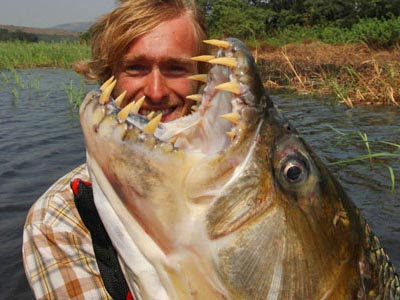
Monster Fish Caught! the Goliath Tiger-fish is a scary looking and deadly creature.
A native of the Congo River basin,Lualaba River and Lake tanganiyika in Africa, the Goliath Tigerfish can reach lengths up to 5 feet and weigh up to 154 pounds.
It is the largest member of a genus of fierce predators with 32 razor sharp, dagger like teeth that can tear through even a solid steel wire.Outclassing any other African game fish in speed and power it loves turbulent waters where less powerful fish struggle, making them vulnerable to attack.Showing now fear of crocodiles, this fearless monster is known to eat smaller ones and has attacked humans in rare instances.It is lightning quick and forceful and can be an anglers worst nightmare because the fish not only will snap a line, but make off with the fishing tackle as well.
This monstrous predator has excellent eyesight and can sense low-frequency vibrations emitted by prey.It strikes with the brutality of piranha and has been reported to attack 60 pound catfish and slicing them in half. Goliath bird eater spider
The Goliath birdeater (Theraphosa blondi) is an arachnid, or spider, belonging to the tarantula family, Theraphosidae. It is considered to be the second largest spider in the world (by leg-span, it is second to the giant huntsman spider), and it may be the largest by mass. Also called the Goliath bird-eating spider, it gets its name from reports of explorers from the Victorian era, who witnessed one eating a hummingbird. Electric Eel - Powers Christmas Tree
The electric eel (Electrophorus electricus) is an electric fish, and the only species of the genus Electrophorus. It is capable of generating powerful electric shocks of up to 600 volts, which it uses for hunting and self-defense. It is an apex predator in its South American range. Despite its name, it is not an eel, but rather a knifefish.
The electric eel has three abdominal pairs of organs that produce electricity: the main organ, the Hunter's organ, and the Sach's organ. These organs make up four-fifths of its body, and are what give the electric eel the ability to generate two types of electric organ discharges - low voltage and high voltage. These organs are made of electrocytes, lined up so a current of ions can flow through them and stacked so each one adds to a potential difference. When the eel locates its prey, the brain sends a signal through the nervous system to the electrocytes. This opens the ion channels, allowing sodium to flow through, reversing the polarity momentarily. By causing a sudden difference in electric potential, it generates an Electric current in a manner similar to a battery, in which stacked plates each produce an electrical potential difference. In the electric eel, some 5,000 to 6,000 stacked electroplaques are capable of producing a shock at up to 500 volts and 1 ampere of current (500 watts). Such a shock could be deadly for an adult human. Electrocution death is due to current flow; the level of current can be fatal in humans depending on the path the current takes through the human body. Heart fibrillation (which is reversible via a heart defibrillator) can take place from currents ranging from 70 to 700 mA and higher. Anaconda vs. Human
An anaconda is a large, nonvenomous snake found in tropical South America. Although the name actually applies to a group of snakes, it is often used to refer only to one species in particular, the common or green anaconda, Eunectes murinus, which is one of the largest snakes in the world.
Anaconda may refer to:
Any member of the genus Eunectes, a group of large, aquatic snakes found in South America
Eunectes murinus, the green anaconda, the largest species, is found east of the Andes in Colombia, Venezuela, the Guianas, Ecuador, Peru, Bolivia, Brazil and Trinidad and Tobago.
Eunectes notaeus, the yellow anaconda, a smaller species, is found in eastern Bolivia, southern Brazil, Paraguay and northeastern Argentina.
Eunectes deschauenseei, the dark-spotted anaconda, is a rare species found in northeastern Brazil and coastal French Guiana.
Eunectes beniensis, the Bolivian anaconda, the most recently defined species, is found in the Departments of Beni and Pando in Bolivia.
The giant anaconda is a mythical snake of enormous proportions said to be found in South America.
Any large snake that "crushes" its prey, if applied loosely, could be called anaconda.
 樓主: 庹宗康
 Tattoo Girls !





 在線雷達
在線雷達


 發表於 2012-12-2 11:45:35

















 發表於 2012-12-2 13:26:03