找回密碼
 註冊
樓主: Juven

[宇宙天文] 神秘又美麗的銀河系

   火... [複製鏈接]
 樓主| 發表於 2012-11-29 15:26:05 | 顯示全部樓層
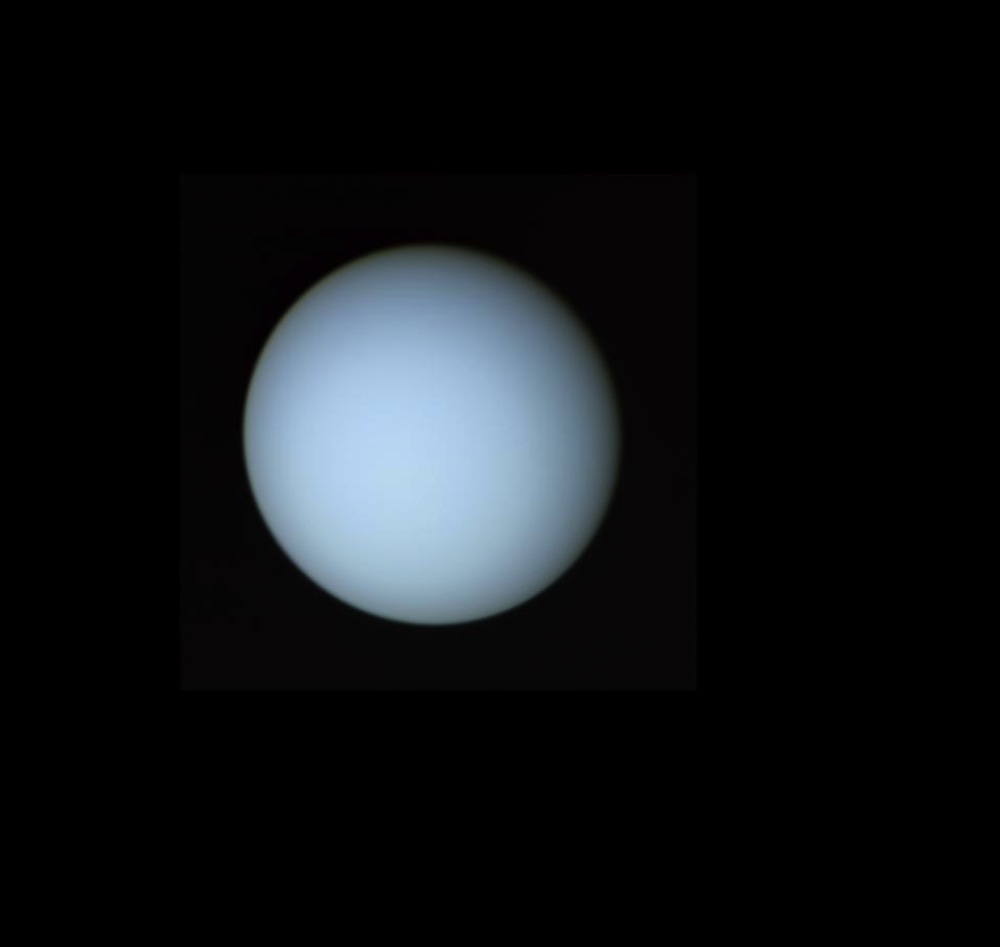
Uranus 天王星

These two pictures of Uranus were compiled from images recorded by Voyager 2 on Jan. 10, 1986, when the NASA spacecraft was 18 million kilometers (11 million miles) from the planet. The images were obtained by Voyager's narrow-angle camera; the view is toward the planet's pole of rotation, which lies just left of center. The picture on the left has been processed to show Uranus as human eyes would see it from the vantage point of the spacecraft. The second picture is an exaggerated false-color view that reveals details not visible in the true-color view -- including indications of what could be a polar haze of smog-like particles.

20120302.jpg

The true-color picture was made by combining pictures taken through blue, green and orange filters. The dark shading of the upper right edge of the disk is the terminator, or day-night boundary. The blue-green appearance of Uranus results from methane in the atmosphere; this gas absorbs red wavelengths from the incoming sunlight, leaving the predominant bluish color seen here. The picture on the right uses false color and contrast enhancement to bring out subtle details in the polar region of the atmosphere. Images shuttered through different color filters were added and manipulated by computer, greatly enhancing the low-contrast details in the original images. Ultraviolet, violet- and orange-filtered images were displayed, respectively, as blue, green and red to produce this false-color picture. The planet reveals a dark polar hood surrounded by a series of progressively lighter convective bands. The banded structure is real, though exaggerated here. The brownish color near the center of the planet could be explained as being caused by a thin haze concentrated over the pole -- perhaps the product of chemical reactions powered by ultraviolet light from the Sun. One such reaction produces acetylene from methane -- acetylene has been detected on Uranus by an Earth-orbiting spacecraft -- and further reactions involving acetylene are known to produce reddish-brown smog-like particles. A similar haze envelopes Saturn's moon Titan; ground-based observations have predicted such a haze in the polar regions of Uranus. The exact identification of the reactions and their products will require additional study.
回覆 讚好 不讚 使用道具

舉報

 樓主| 發表於 2012-11-29 15:27:20 | 顯示全部樓層
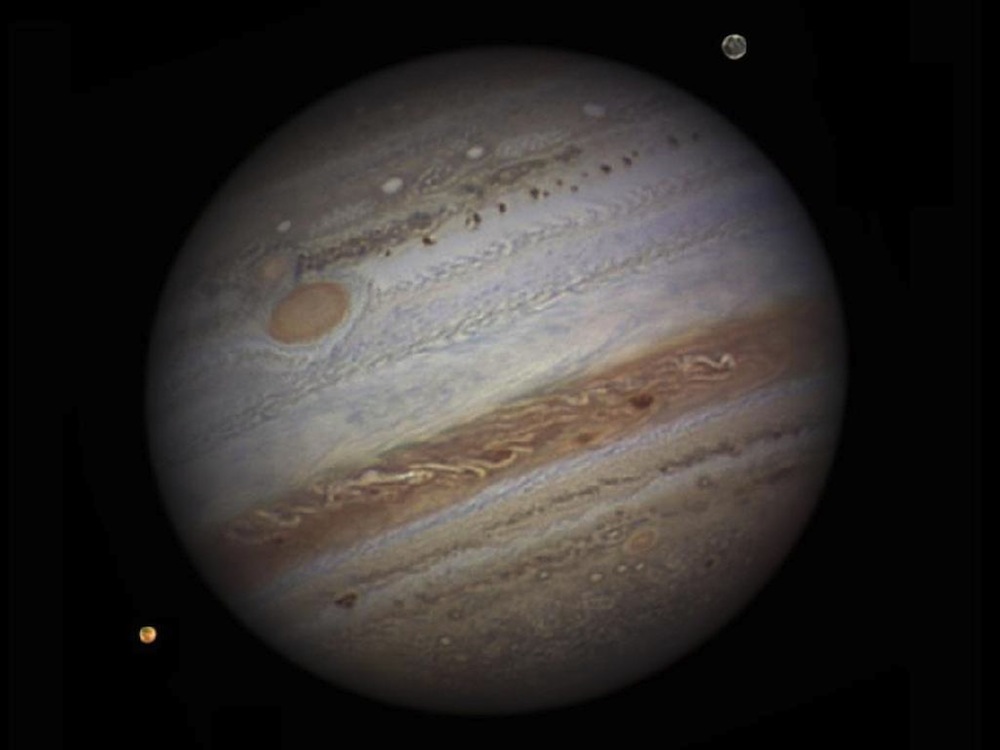
Amateur Jupiter Shot 木星

This image of Jupiter and its moons Io and Ganymede was acquired by amateur astronomer Damian Peach on Sept. 12, 2010, when Jupiter was close to opposition. South is up and the "Great Red Spot" is visible in the image.

20120305.jpg

Ground-based astronomy will play a vital role in the success of NASA's Juno mission. Because Jupiter has such a dynamic atmosphere, images from amateur astronomers will assist the JunoCam instrument team predict what features will be visible when the camera's images are taken.

With its suite of science instruments, the Juno spacecraft will investigate the existence of a solid planetary core, map the planet's intense magnetic field, measure the amount of water and ammonia in the deep atmosphere and observe the planet's auroras.

回覆 讚好 不讚 使用道具

舉報

 樓主| 發表於 2012-11-29 15:29:39 | 顯示全部樓層
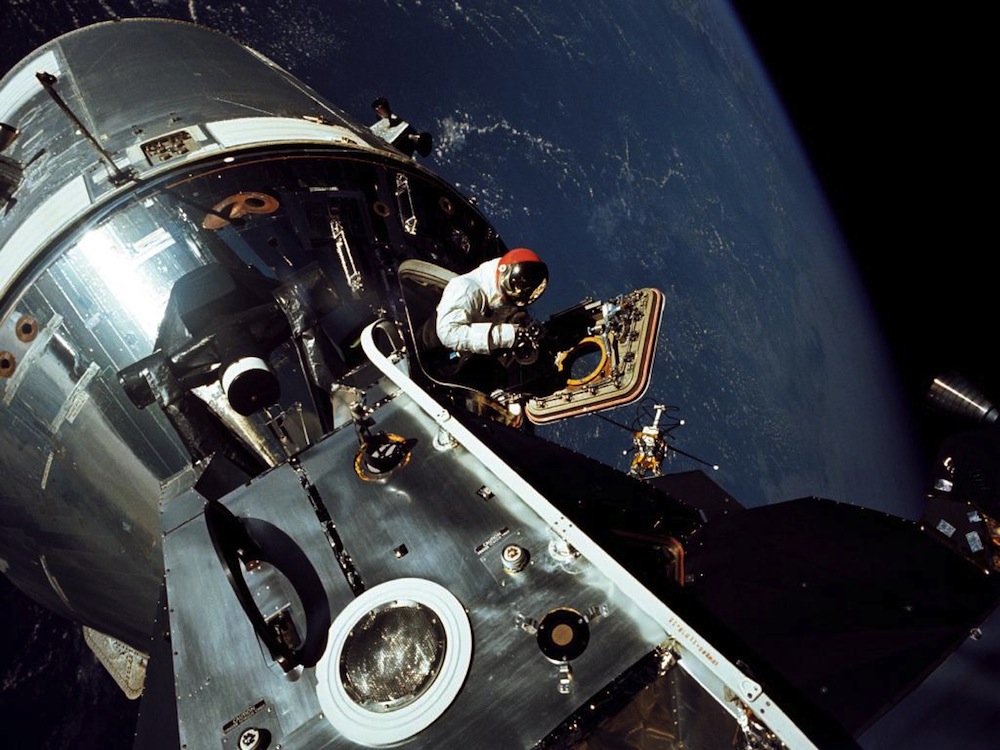
Rendezvous in Space 太空中接合

This image, taken on March 6, 1969, shows the Apollo 9 Command and Service Modules docked with the Lunar Module. Apollo 9 astronaut Dave Scott stands in the open hatch of the Command Module, nicknamed "Gumdrop," docked to the Lunar Module "Spider" in Earth orbit. His crewmate Rusty Schweickart, lunar module pilot, took this photograph from the porch of the lunar module. Inside the lunar module was Apollo 9 commander Jim McDivitt. The crew tested the orbital rendezvous and docking procedures that made the lunar landings possible.

20120306.jpg
回覆 讚好 不讚 使用道具

舉報

 樓主| 發表於 2012-11-29 15:30:53 | 顯示全部樓層
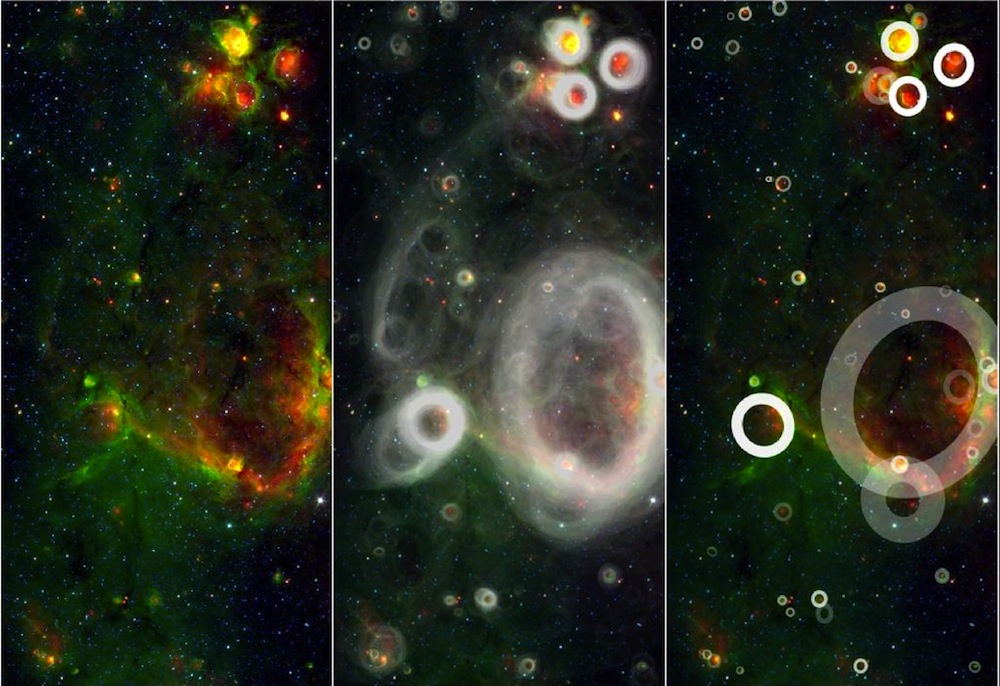
Milky Way Bubbles 銀河泡沫

A team of volunteers from the general public has pored over observations from NASA's Spitzer Space Telescope and discovered more than 5,000 "bubbles" in the disk of our Milky Way galaxy. Young, hot stars blow the bubbles into surrounding gas and dust, highlighting areas of brand new star formation.

Upwards of 35,000 "citizen scientists" sifted through the Spitzer infrared data as part of the online Milky Way Project to find these telltale bubbles. The users have turned up 10 times as many bubbles as previous surveys so far.


20120307.jpg

Volunteers for the project are shown a small section of Spitzer’s huge infrared Milky Way image (left), which they then scan for cosmic bubbles. Using a sophisticated drawing tool, the volunteers trace the shape and thickness of the bubbles.

All the user drawings can be overlaid on top of one another to form a so-called “heat map” (middle). Features that have been identified repeatedly by many different users jump out, revealing the overall pattern of bubbles in this part of the galaxy.

At least five volunteers must flag a candidate bubble before it is included in the final catalog (right). The brightness of each bubble in the catalog is determined by its “hit rate,” or the fraction of users who traced it out. The faintest ones were identified by 10 percent of the users, while solid white indicates a hit rate of 50 percent or better.

After identifying all apparent bubbles, which can include wispy arcs of partially broken rings and the circles-within-circles of overlapping bubbles, volunteers get another of the 12,263 possible image sections to scrutinize. With so much sky to cover, it is clear why so many volunteers are needed to do this kind of science.
回覆 讚好 不讚 使用道具

舉報

 樓主| 發表於 2012-11-29 15:32:34 | 顯示全部樓層
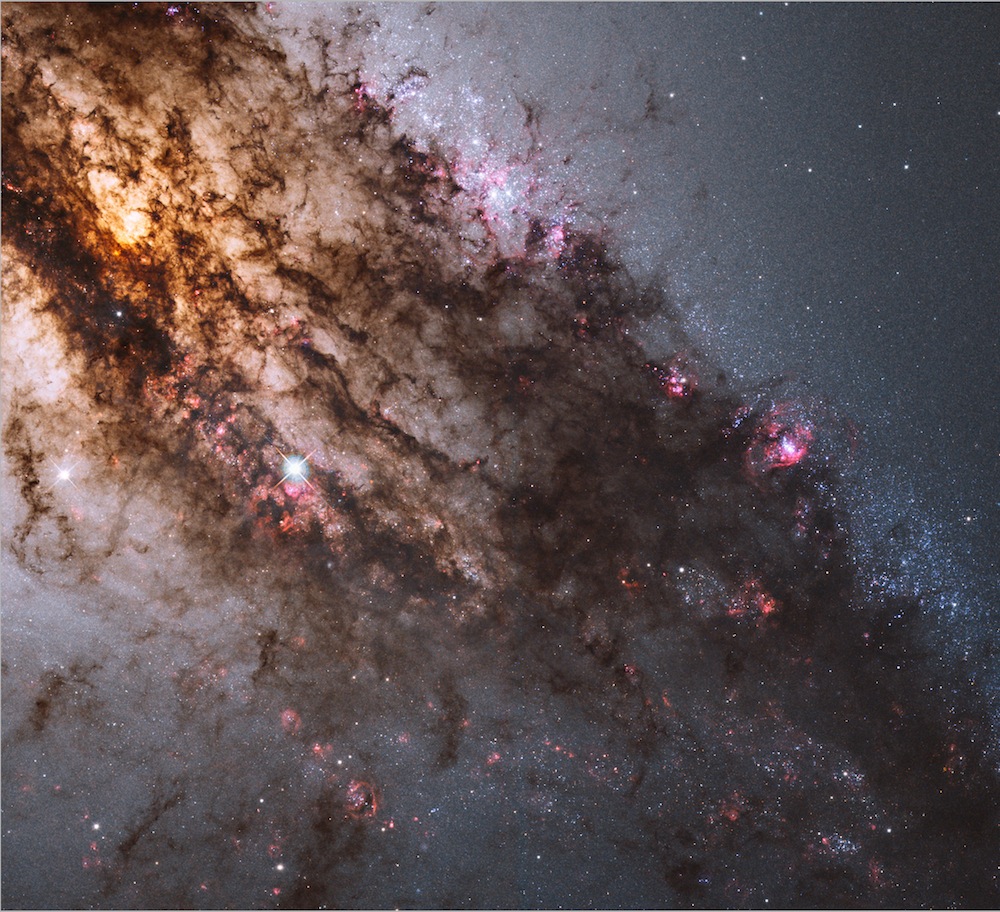
Star Birth in Centarus 半人馬星座的新星誕生

Resembling looming rain clouds on a stormy day, dark lanes of dust crisscross the giant elliptical galaxy Centaurus A.

Hubble's panchromatic vision, stretching from ultraviolet through near-infrared wavelengths, reveals the vibrant glow of young, blue star clusters and a glimpse into regions normally obscured by the dust.


20120308.jpg

The warped shape of Centaurus A's disk of gas and dust is evidence for a past collision and merger with another galaxy. The resulting shockwaves cause hydrogen gas clouds to compress, triggering a firestorm of new star formation. These are visible in the red patches in this Hubble close-up.

At a distance of just over 11 million light-years, Centaurus A contains the closest active galactic nucleus to Earth. The center is home for a supermassive black hole that ejects jets of high-speed gas into space, but neither the supermassive black hole or the jets are visible in this image.
回覆 讚好 不讚 使用道具

舉報

 樓主| 發表於 2012-11-29 15:34:05 | 顯示全部樓層
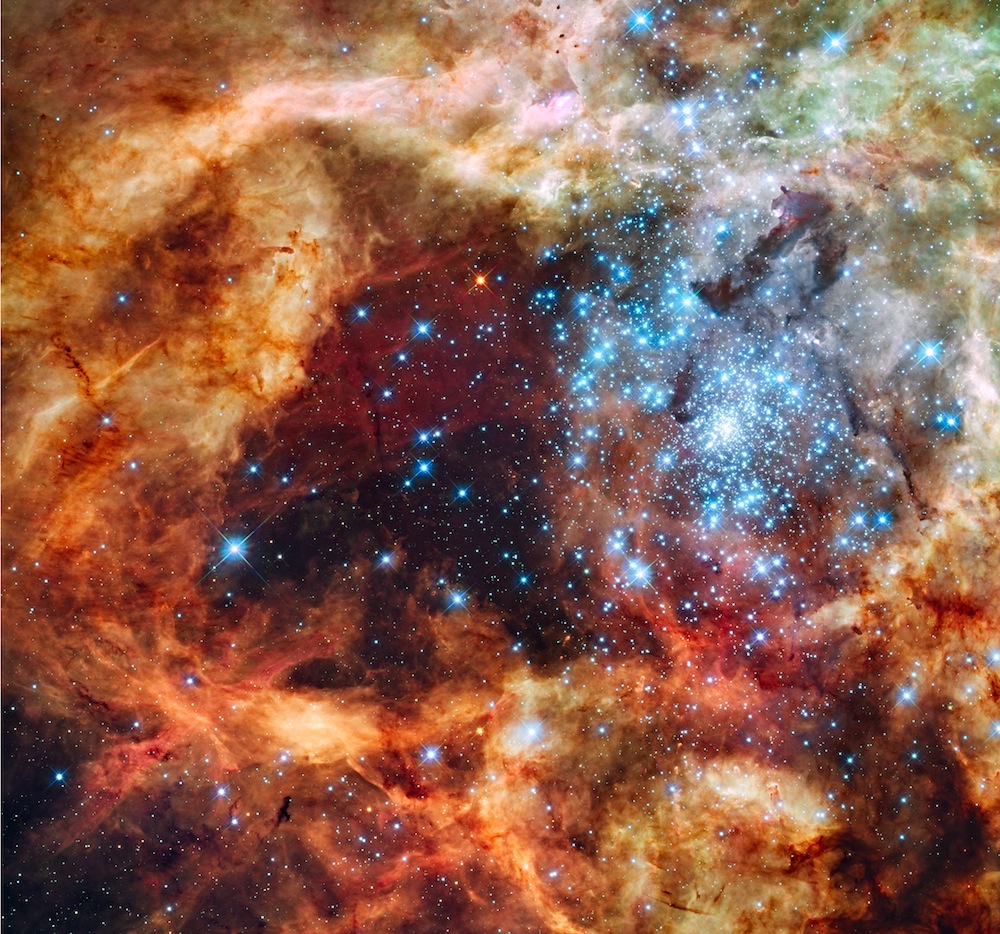
Stellar Nursery in Doradus 劍魚座的恆星托兒所

This massive, young stellar grouping, called R136, is only a few million years old and resides in the 30 Doradus Nebula, a turbulent star-birth region in the Large Magellanic Cloud, a satellite galaxy of the Milky Way. There is no known star-forming region in the Milky Way Galaxy as large or as prolific as 30 Doradus.

Many of the diamond-like icy blue stars are among the most massive stars known. Several of them are 100 times more massive than our sun. These hefty stars are destined to pop off, like a string of firecrackers, as supernovas in a few million years.

20120309.jpg

The image, taken in ultraviolet, visible and red light by Hubble's Wide Field Camera 3, spans about 100 light-years. The nebula is close enough to Earth that Hubble can resolve individual stars, giving astronomers important information about the stars' birth and evolution.

The brilliant stars are carving deep cavities in the surrounding material by unleashing a torrent of ultraviolet light, and hurricane-force stellar winds (streams of charged particles), which are etching away the enveloping hydrogen gas cloud in which the stars were born. The image reveals a fantasy landscape of pillars, ridges, and valleys, as well as a dark region in the center that roughly looks like the outline of a holiday tree. Besides sculpting the gaseous terrain, the brilliant stars can also help create a successive generation of offspring. When the winds hit dense walls of gas, they create shocks, which may be generating a new wave of star birth.

These observations were taken Oct. 20-27, 2009. The blue color is light from the hottest, most massive stars; the green from the glow of oxygen; the red from fluorescing hydrogen.
回覆 讚好 不讚 使用道具

舉報

 樓主| 發表於 2012-11-29 15:35:25 | 顯示全部樓層
Devil on Mars 火星上的魔鬼

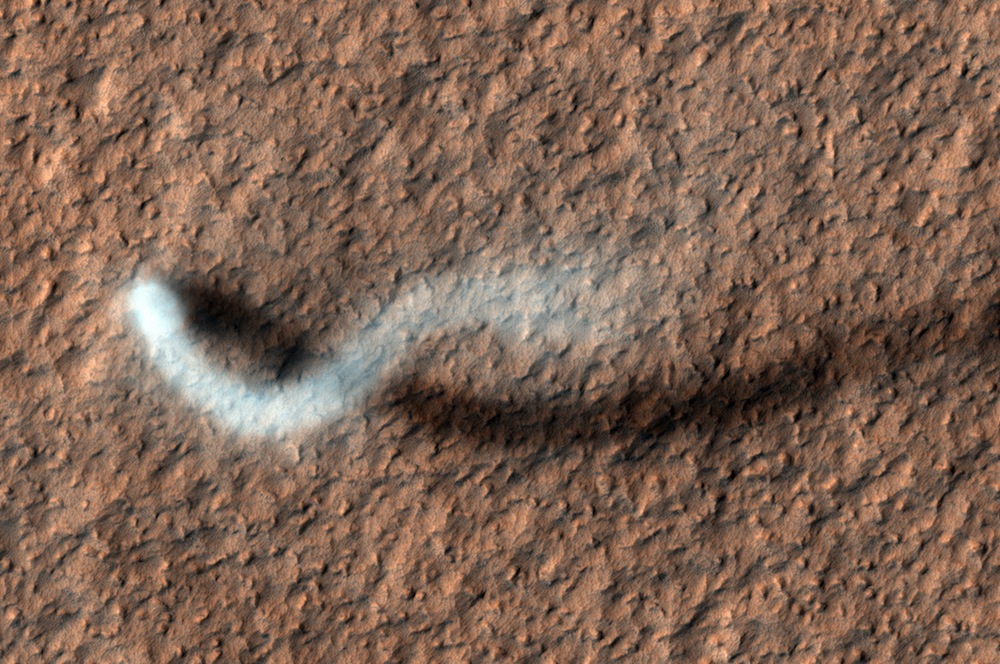
A towering dust devil casts a serpentine shadow over the Martian surface in this stunning, late springtime image of Amazonis Planitia.

The length of the shadow indicates that the dust plume reaches more than 800 meters, or half a mile, in height. The tail of the plume does not trace the path of the dust devil, which had been following a steady course towards the southeast and left a bright track behind it.


20120312.jpg

The delicate arc in the plume was produced by a westerly breeze at about a 250-meter height that blew the top of the plume towards the east. The westerly winds and the draw of warmth to the south combine to guide dust devils along southeast trending paths, as indicated by the tracks of many previous dust-devils. The dust plume itself is about 30 meters in diameter.

Numerous bright tracks trend from northwest to southeast. It is interesting to see that these tracks are bright, whereas dust-devil tracks elsewhere on Mars are usually dark. Dark tracks are believed to form where bright dust is lifted from the surface by dust devils, revealing a darker substrate.

Here in Amazonis, the dust cover is too thick to be penetrated by such scouring. A blanket of bright dust was deposited over this region recently, just before the arrival of MRO, so the surface dust here can still be moved. Perhaps the bright tracks form when the settled dust is stirred up by the strong winds generated by the dust devils (tangential wind speeds of up to 70 miles per hour have been recorded in HiRISE images of other dust devils).

It's also interesting that this image was taken during the time of year when Mars is farthest from the Sun. Just as on Earth, Martian winds are powered by solar heating. Exposure to the sun's rays should be at a minimum during this season, yet even now, dust devils act relentlessly to clean the surface of freshly deposited dust, a little at a time.
回覆 讚好 不讚 使用道具

舉報

 樓主| 發表於 2012-11-29 15:49:27 | 顯示全部樓層
Rhea Close-Up 瑞亞

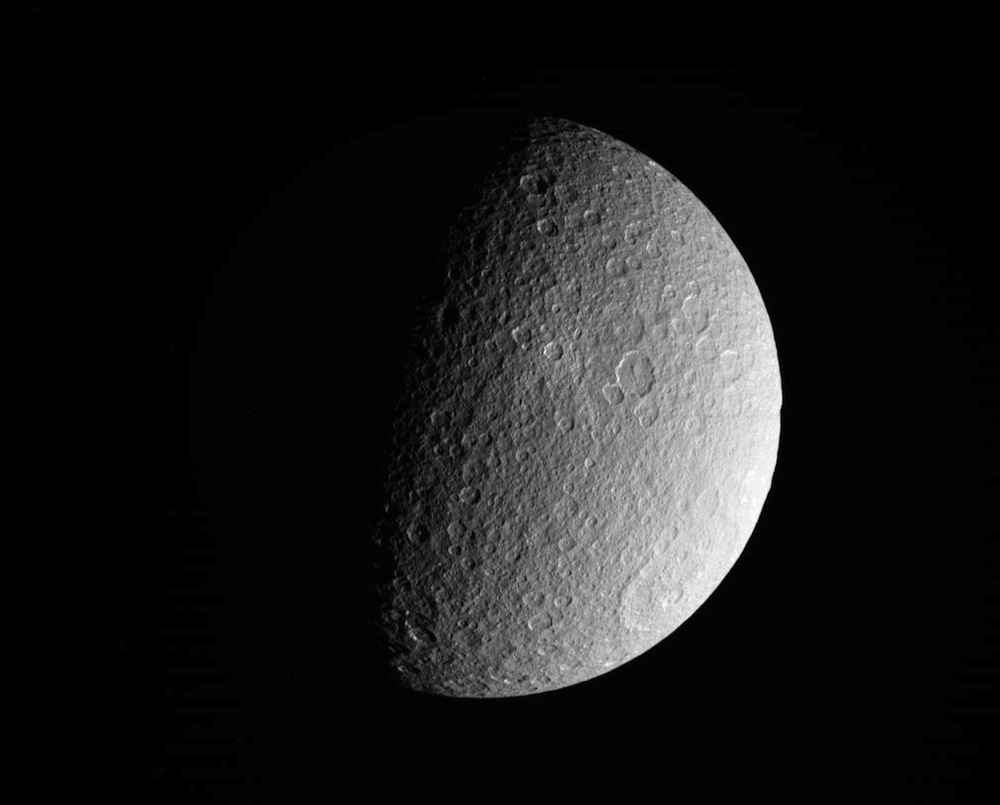
These raw, unprocessed images of Saturn's second largest moon, Rhea, were taken on March 10, 2012, by NASA's Cassini spacecraft. This was a relatively distant flyby with a close-approach distance of 26,000 miles (42,000 kilometers), well suited for global geologic mapping.

20120313.jpg

During the flyby, Cassini captured these distinctive views of the moon's cratered surface, creating a 30-frame mosaic of Rhea's leading hemisphere and the side of the moon that faces away from Saturn. The observations included the large Mamaldi (300 miles, or 480 kilometers, across) and Tirawa (220 miles, or 360 kilometers, across) impact basins and the 29-mile (47-kilometer) ray crater Inktomi, one of the youngest surface features on Rhea (about 950 miles, or 1,530 kilometers, across).
回覆 讚好 不讚 使用道具

舉報

 樓主| 發表於 2012-11-29 15:51:06 | 顯示全部樓層
Teenage Galaxies 年輕的星系

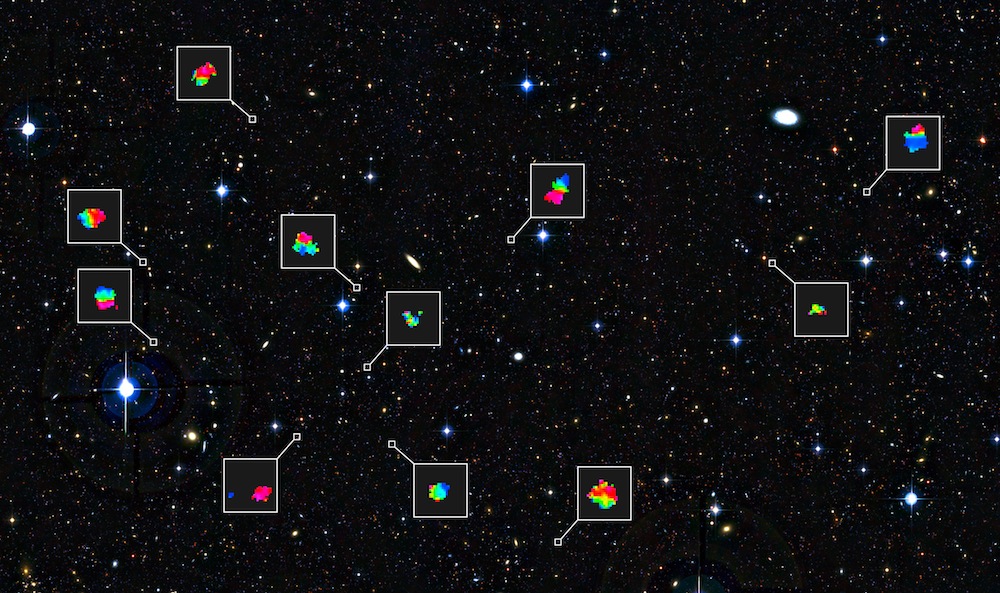
This deep view of a tiny patch of sky in the constellation of Cetus (The Sea Monster) shows a selection of galaxies that were used in a new survey of the feeding habits of young galaxies as they grew through cosmic time. Each of the tiny blobs, galaxies seen as they were between three and five billion years after the Big Bang, has been studied in detail using ESO’s VLT and the SINFONI instrument. The color maps show the motions of the gas in the galaxies. Blue indicates that the gas is moving towards us, compared to the galaxy as a whole, and red that the gas is receding. These colors allow astronomers to see if the galaxies is rotating like a disc or has some other behaviour.

20120314.jpg
回覆 讚好 不讚 使用道具

舉報

 樓主| 發表於 2012-11-29 15:52:20 | 顯示全部樓層
Enceladus With Spouts 土衛二

Below a darkened Enceladus, a plume of water ice is backlit in this view of one of Saturn's most dramatic moons.

Dramatic plumes, both large and small, spray water ice from many locations along the moon's famed "tiger stripes" near the south pole of Enceladus. The tiger stripes are fissures that spray icy particles, water vapor and organic compounds.


20120315.jpg

The terrain seen here is on the leading hemisphere of Enceladus (313 miles, or 504 kilometers across). North is up. The image was taken in visible light with the Cassini spacecraft narrow-angle camera on Feb. 20, 2012. The view was acquired at a distance of approximately 83,000 miles (134,000 kilometers) from Enceladus and at a Sun-Enceladus-spacecraft, or phase, angle of 165 degrees. Image scale is 2,628 feet (801 meters) per pixel.
回覆 讚好 不讚 使用道具

舉報

 樓主| 發表於 2012-11-29 15:53:33 | 顯示全部樓層
Thanks for your support.gif
回覆 讚好 不讚 使用道具

舉報

2189

主題

4萬

回帖

24萬

積分

究極元老

人生就是充滿高低起跌才精彩

積分
243350

「玩具模型」勳章熱爆勳章百萬富翁勳章千億富豪勳章精華帖王勳章萬千寵愛勳章141榮譽勳章論譠元老勳章高級元老勳章超級元老勳章究極元老勳章「天蠍座」勳章傑出成就勳章「友誼大使」勳章「貼圖之星」勳章「戲劇之王」勳章「博學多才」勳章「體育精神」勳章「能言善辯」勳章「型男嗜好」勳章「動漫一族」勳章「音樂大師」勳章「數碼達人」勳章「141玩家」勳章「性愛專家」勳章「AV達人」勳章「攝影達人」勳章「創作大師」勳章「神州之星」勳章「遊藝專家」勳章「棋藝大師」勳章「玄機妙算」勳章「電腦大師」勳章「生活常識」勳章「演藝傳播」勳章「飲食健康」勳章「觀星入門」勳章「旅遊/航空」勳章「痴線佬」勳章特嗜章收藏家勳章「潮流時尚」勳章「單車交流」勳章「廣告/設計」勳章「爬山遠足」勳章「寶島之星」勳章「爆笑王」勳章「影音Hi-Fi」勳章「廚師食譜」勳章「資訊情報」分區勳章「資源分享」分區勳章「消閒興趣」分區勳章「會員交流」分區勳章「各行各業」分區勳章勝利勳章141紳士勳章成家立室勳章

發表於 2012-11-29 15:56:31 | 顯示全部樓層
好多雞..............................................


................腸呀.....

強者之所以成為強者,是因為強人擅長戰勝自己的脆弱
回覆 讚好 不讚 使用道具

舉報

67

主題

2361

回帖

100

積分

初級會員

積分
100

「貼圖之星」勳章

發表於 2012-11-29 16:07:02 | 顯示全部樓層
神秘又奇异. Very good post, lots of information, the milky way is very fascinating
回覆 讚好 不讚 使用道具

舉報

4148

主題

32萬

回帖

169萬

積分

141正式版主

開開心心過每天

積分
1692292

「資源分享」分區勳章「賭神」勳章「魚樂無窮」勳章「首寵飼蟲」勳章「鵲鳥奇鸚」勳章「陽光田園」勳章「觀星入門」勳章「消閒興趣」分區勳章「車迷天地」勳章「廚師食譜」勳章特嗜章「影音Hi-Fi」勳章「各行各業」分區勳章「動漫一族」勳章「自然大使」勳章「玩具模型」勳章熱爆勳章「廣告/設計」勳章「AV達人」勳章「旅遊/航空」勳章「潮流時尚」勳章收藏家勳章百萬富翁勳章千億富豪勳章精華帖王勳章萬千寵愛勳章傑出成就勳章論譠元老勳章高級元老勳章超級元老勳章究極元老勳章「摩羯座」勳章「友誼大使」勳章「貼圖之星」勳章「能言善辯」勳章「型男嗜好」勳章「攝影達人」勳章「創作大師」勳章「生活常識」勳章「會員交流」分區勳章版主勳章群組紀念勳章勝利勳章141紳士勳章成家立室勳章「戲劇之王」勳章「音樂大師」勳章141榮譽勳章十萬帖勳章

發表於 2012-11-29 16:09:17 | 顯示全部樓層
D番文好深⋯至多明一半⋯
人生得意須盡歡,莫使金樽空對月。天生我材必有用,千金散盡還復來。
將進酒,杯莫停。與君歌一曲,請君為我側耳聽。
鐘鼓饌玉不足貴,但願長醉不願醒。古來聖賢皆寂寞,惟有飲者留其名。
回覆 讚好 不讚 使用道具

舉報

964

主題

6萬

回帖

60

積分

初級會員

淡泊明志 寧靜致遠

積分
60

百萬富翁勳章精華帖王勳章萬千寵愛勳章傑出成就勳章141榮譽勳章論譠元老勳章高級元老勳章超級元老勳章究極元老勳章「天蠍座」勳章「友誼大使」勳章「貼圖之星」勳章「博學多才」勳章「型男嗜好」勳章「動漫一族」勳章「141玩家」勳章「性愛專家」勳章「神州之星」勳章「觀星入門」勳章「旅遊/航空」勳章「痴線佬」勳章「消閒興趣」分區勳章「各行各業」分區勳章長時間服務勳章終身成就勳章勝利勳章141紳士勳章成家立室勳章

發表於 2012-11-29 16:21:00 | 顯示全部樓層
Juven 發表於 2012-11-29 15:51
Teenage Galaxies 年輕的星系

This deep view of a tiny patch of sky in the constellation of Cetus (Th ...

呢幅真係好少見,其他看很多。
回覆 讚好 不讚 使用道具

舉報

208

主題

6757

回帖

100

積分

初級會員

日日做到無停手!!!!!

積分
100

百萬富翁勳章萬千寵愛勳章論譠元老勳章高級元老勳章超級元老勳章「獅子座」勳章傑出成就勳章「友誼大使」勳章「數碼達人」勳章「各行各業」分區勳章群組紀念勳章141紳士勳章成家立室勳章百萬富翁勳章

發表於 2012-11-29 16:24:18 | 顯示全部樓層
人類對比宇宙幾咁渺小,連最近自己既行星都未去到!!
回覆 讚好 不讚 使用道具

舉報

發表於 2012-11-29 16:24:43 | 顯示全部樓層
淡淡然掠過 神秘又美麗,它恍似驟來的雨.........
可惜係......禾真係唔識
回覆 讚好 不讚 使用道具

舉報

164

主題

1萬

回帖

14萬

積分

究極元老

萬 寶 龍

積分
142487

百萬富翁勳章精華帖王勳章萬千寵愛勳章論譠元老勳章高級元老勳章超級元老勳章究極元老勳章「天秤座」勳章傑出成就勳章「友誼大使」勳章「博學多才」勳章「型男嗜好」勳章「自然大使」勳章「玄機妙算」勳章「飲食健康」勳章「旅遊/航空」勳章「潮流時尚」勳章「車迷天地」勳章「資訊情報」分區勳章「消閒興趣」分區勳章「會員交流」分區勳章版主勳章141榮譽勳章

發表於 2012-11-29 16:27:21 | 顯示全部樓層
宇宙浩瀚, 無限精彩 !! Thanks for beautiful pictures and detailed description.   
回覆 讚好 不讚 使用道具

舉報

發表於 2012-11-29 16:46:56 | 顯示全部樓層
淡淡然略過神秘又美麗
回覆 讚好 不讚 使用道具

舉報

467

主題

2萬

回帖

8萬

積分

超級元老

禾餓底,禾扯火,矛惹禾,禾系頭號空姐迷•

積分
83420

成家立室勳章「貼圖之星」勳章「攝影達人」勳章「創作大師」勳章「會員交流」分區勳章「旅遊/航空」勳章熱心捐助勳章百萬富翁勳章「友誼大使」勳章論譠元老勳章高級元老勳章萬千寵愛勳章傑出成就勳章超級元老勳章精華帖王勳章究極元老勳章141榮譽勳章

發表於 2012-11-29 16:51:54 | 顯示全部樓層
螺旋星系好特別
→有今生,無來世,向Kobe Bryant致敬•(14/04/2016退役)

You asked for my hustle,I gave you my heart•
回覆 讚好 不讚 使用道具

舉報

您需要登錄後才可以回帖 登錄 | 註冊

本版積分規則

Archiver|聯絡我們|141華人社區

GMT+8, 2025-12-1 13:37

Powered by Discuz! X3.5

© 2001-2025 Discuz! Team.

快速回覆 返回頂部 返回列表