An aurorais a natural light display in the sky particularly in the high latitude (Arctic and Antarctic) regions, caused by the collision of energetic charged particles with atoms in the high altitude atmosphere (thermosphere). The charged particles originate in the magnetosphere and solar wind and, on Earth, are directed by the Earth's magnetic field into the atmosphere. Aurora is classified as diffuse or discrete aurora. Aurora Borealis Aura
Most aurorae occur in a band known as the auroral zone, which is typically 3° to 6° in latitudinal extent and at all local times or longitudes. The auroral zone is typically 10° to 20° from the magnetic pole defined by the axis of the Earth's magnetic dipole. During a geomagnetic storm, the auroral zone will expand to lower latitudes. The diffuse aurora is a featureless glow in the sky which may not be visible to the naked eye even on a dark night and defines the extent of the auroral zone. The Northern Lights (Aurora Borealis) in Finland
The discrete aurorae are sharply defined features within the diffuse aurora which vary in brightness from just barely visible to the naked eye to bright enough to read a newspaper at night. Discrete aurorae are usually observed only in the night sky because they are not as bright as the sunlit sky. Aurorae occasionally occur poleward of the auroral zone as diffuse patches or arcs (polar cap arcs), which are generally invisible to the naked eye. Northern Lights - The Sky At Night
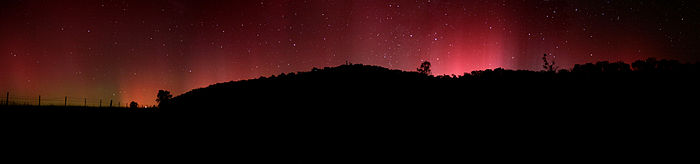
In northern latitudes, the effect is known as the aurora borealis (or the northern lights), named after the Roman goddess of dawn, Aurora, and the Greek name for the north wind, Boreas, by Pierre Gassendi in 1621. Auroras seen near the magnetic pole may be high overhead, but from farther away, they illuminate the northern horizon as a greenish glow or sometimes a faint red, as if the Sun were rising from an unusual direction.
*Dr Chris Lintott travels to a radar facility in northern Norway to discover how the magical Aurora Borealis are created. Amazing Northern Lights Time Lapse 2012
Discrete aurorae often display magnetic field lines or curtain-like structures, and can change within seconds or glow unchanging for hours, most often in fluorescent green. The aurora borealis most often occurs near the equinoctes. The northern lights have had a number of names throughout history. The Cree call this phenomenon the "Dance of the Spirits". In Europe, in the Middle Ages, the auroras were commonly believed a sign from God.
*March 21, 2012 — Multicolored curtains of light fill the skies over northern Norway in a new time-lapse video made from aurora images taken this month. Filmmakers Claus and Anneliese Possberg used about 600 frames to create the video. Listening to Northern Lights
Its southern counterpart, the aurora australis (or the southern lights), has almost identical features to the aurora borealis and changes simultaneously with changes in the northern auroral zone and is visible from high southern latitudes in Antarctica, South America, New Zealand, and Australia.
Aurorae occur on other planets. Similar to the Earth's aurora, they are visible close to the planet's magnetic poles.
*A Minnesota Planetarium Video- Natural Radio: When solar flares hit the Earth's magnetic field, the skies at both poles can light up with auroras. The particles also create very low frequency electromagnetic waves, a type of natural radio that can be picked up around the globe. Every year sound recordist Steve McGreevy heads north where the reception is best and points his receiver at the sky. Made for use in the Planetarium dome, thus the circular frame of the images.
 樓主: 鬍鬚子





 在線雷達
在線雷達



 發表於 2012-10-25 01:13:01


















 發表於 2012-10-25 03:35:52










 真系好正,我怕凍去唔到現場睇。