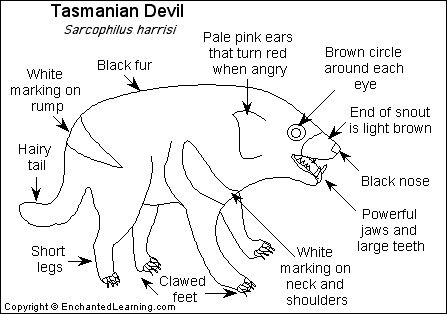
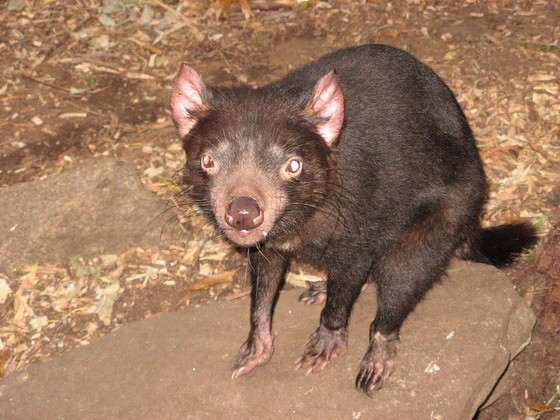
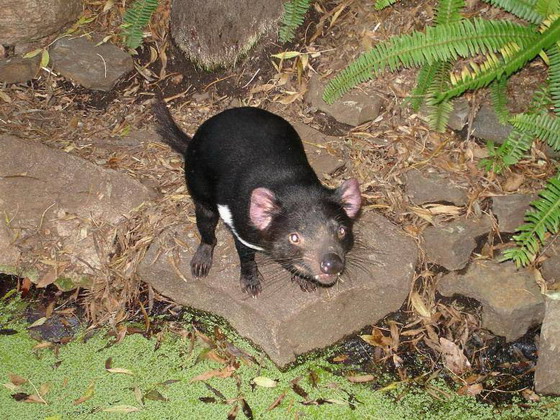
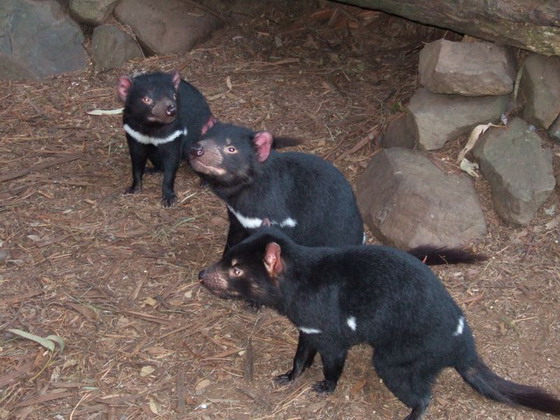
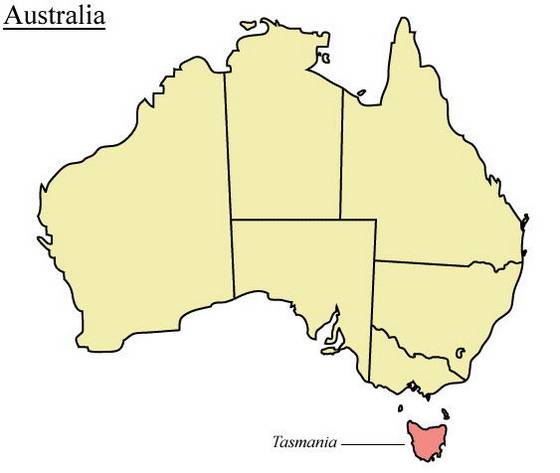
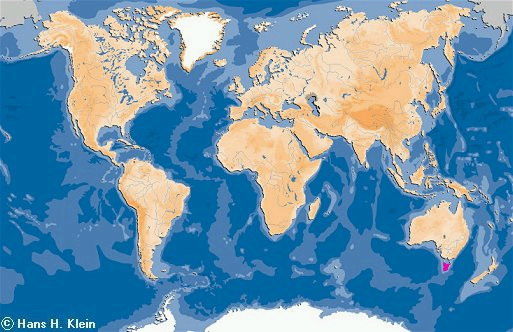
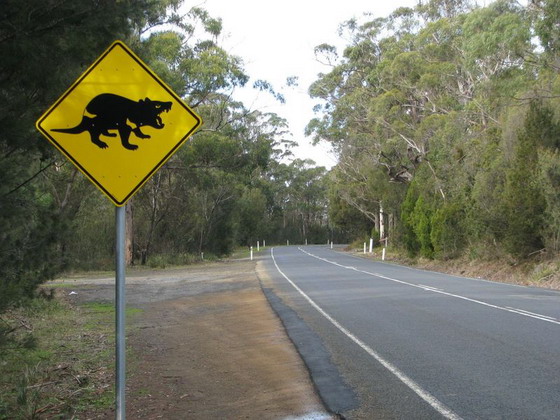
The Tasmanian devil (Sarcophilus harrisii) is a carnivorous marsupial of the family Dasyuridae, now found in the wild only on the Australian island state of Tasmania. The size of a small dog, it became the largest carnivorous marsupial in the world following the extinction of the thylacine in 1936. It is characterised by its stocky and muscular build, black fur, pungent odour, extremely loud and disturbing screech, keen sense of smell, and ferocity when feeding. The Tasmanian devil's large head and neck allow it to generate amongst the strongest bite per unit body mass of any extant land predator, and it hunts prey and scavenges carrion as well as eating household products if humans are living nearby. Although it usually is solitary, it sometimes eats with other devils and defecates in a communal location. Unlike most other dasyurids, the devil thermoregulates effectively and is active during the middle of the day without overheating. Despite its rotund appearance, the devil is capable of surprising speed and endurance, and can climb trees and swim across rivers.
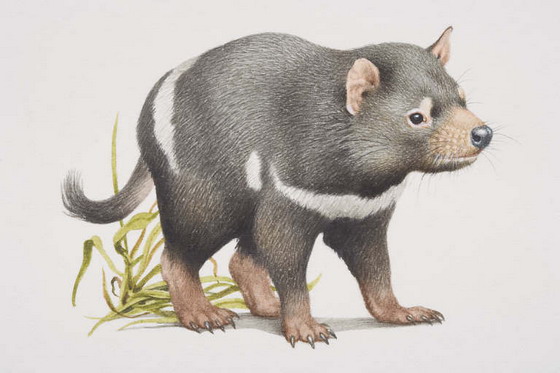
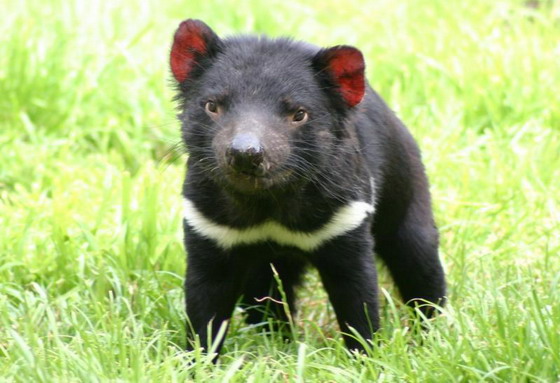
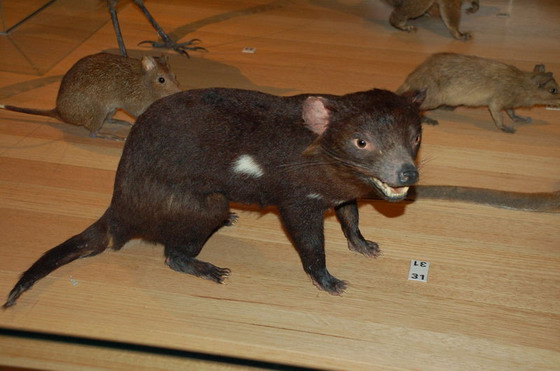
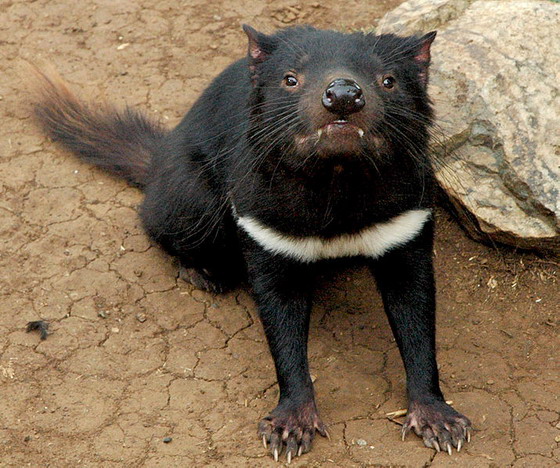
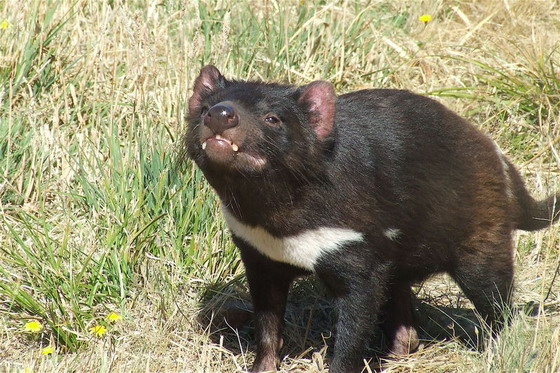
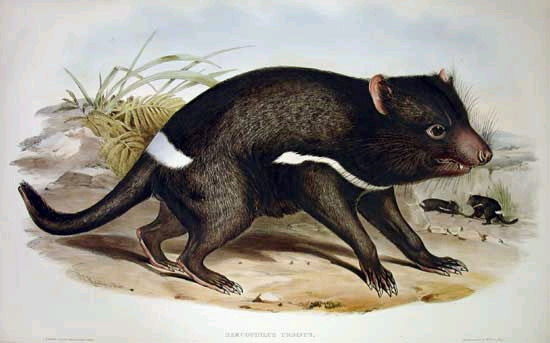
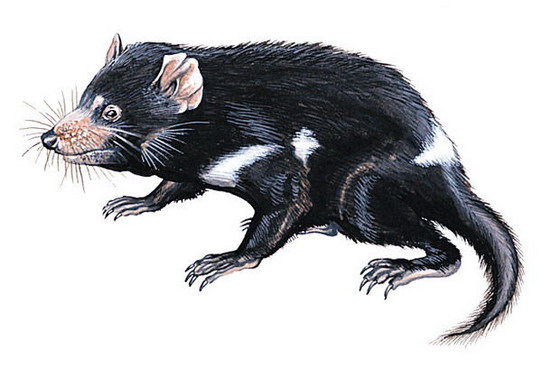
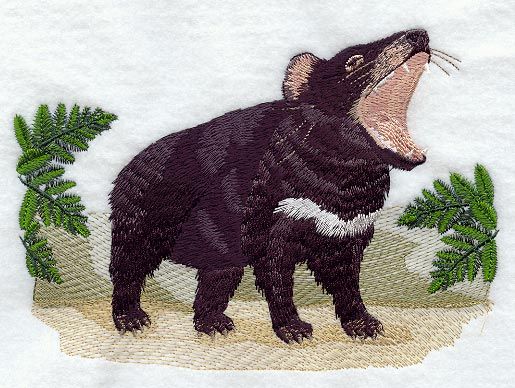
The Tasmanian devil is the largest surviving carnivorous marsupial. It has a squat, thick build, with a large head and a tail which is about half its body length. Unusually for a marsupial, its forelegs are slightly longer than its hind legs, and devils can run up to 13 km/h (8.1 mph) for short distances. The fur is usually black, often with irregular white patches on the chest and rump (although approximately 16% of wild devils do not have white patches). These markings suggest that the devil is most active at dawn and dusk, and they are thought to draw biting attacks toward less important areas of the body, as fighting between devils often leads to a concentration of scars in that region.Males are usually larger than females, having an average head and body length of 652 mm (25.7 in), a 258 mm (10.2 in) tail and an average weight of 8 kg (18 lb). Females have an average head and body length of 570 mm (22 in), a 244 mm (9.6 in) tail and an average weight of 6 kg (13 lb),although devils in western Tasmania tend to be smaller.Devils have five long toes on their forefeet, four pointing to the front and one coming out from the side, which gives the devil the ability to hold food. The hind feet have four toes, and the devils have non-retractable claws.The stocky devils have a relatively low centre of mass.Devils are fully grown at two years of age,and few devils live longer than five years old in the wild.
The devil stores body fat in its tail, and healthy devils have fat tails. The tail is largely non-prehensile and is important to its physiology, social behaviour and locomotion. It acts as a counterbalance to aid stability when the devil is moving quickly.An ano-genital scent gland at the base of its tail is used to mark the ground behind the animal with its strong, pungent scent.
The male has external testes in a pouch-like structure formed by lateral ventrocrural folds of the abdomen, which partially hides and protects them. The testes are subovoid in shape and the mean dimensions of 30 testes of adult males was 3.17 cm × 2.57 cm (1.25 in × 1.01 in).The female's pouch opens backwards, and is present throughout its life, unlike some other dasyurids.





 在線雷達
在線雷達


 發表於 2012-12-11 13:27:49

 廣播
廣播 置頂
置頂 超級提昇
超級提昇 強效提昇
強效提昇 推舊帖
推舊帖 收嗲鳥
收嗲鳥 油顏色
油顏色





 發表於 2012-12-12 20:17:05





















 成隻老鼠,有D似熊